
The Codebase Is Not the Whole Product
What EdTech and Publishing Companies Get Wrong About AI-Native Modernization
- Published on: September 21, 2026
- Updated on: September 24, 2026
- Reading Time: 10 mins
-
Views

System Understanding: Bottlenecks in AI-Native EdTech Product Modernization
A Magic EdTech AI Modernization Case Study
What Causes AI Modernization to Get Stuck at the Understanding Stage?
Problem 1: The Code Shows Behavior, but Rarely Explains Intent
Problem 2: Important Product Behavior Lives Between Systems
How Does Incomplete System Knowledge Cost an EdTech or Publishing Business?
The Business and Timeline Impact
The Product, Team, and User Impact
How Do You Sequence AI-Native Modernization the Right Way?
1. Run a System-Comprehension Preflight Before Full Delivery
2. Document the Product, Not Just the New Code
Why This AI-Modernization Sequencing Pays Off
So, What’s the Lesson?
FAQs
AI-assisted modernization can inspect an unfamiliar codebase, identify its modules and dependencies, generate new code, and document what it finds far faster than traditional discovery. In a recent engagement I led, our AI-enabled workflow produced an application inventory that closely matched the one created by the incumbent vendor, even though our team was seeing the codebase for the first time.
So the problem was never that AI could not make sense of undocumented code. It could.
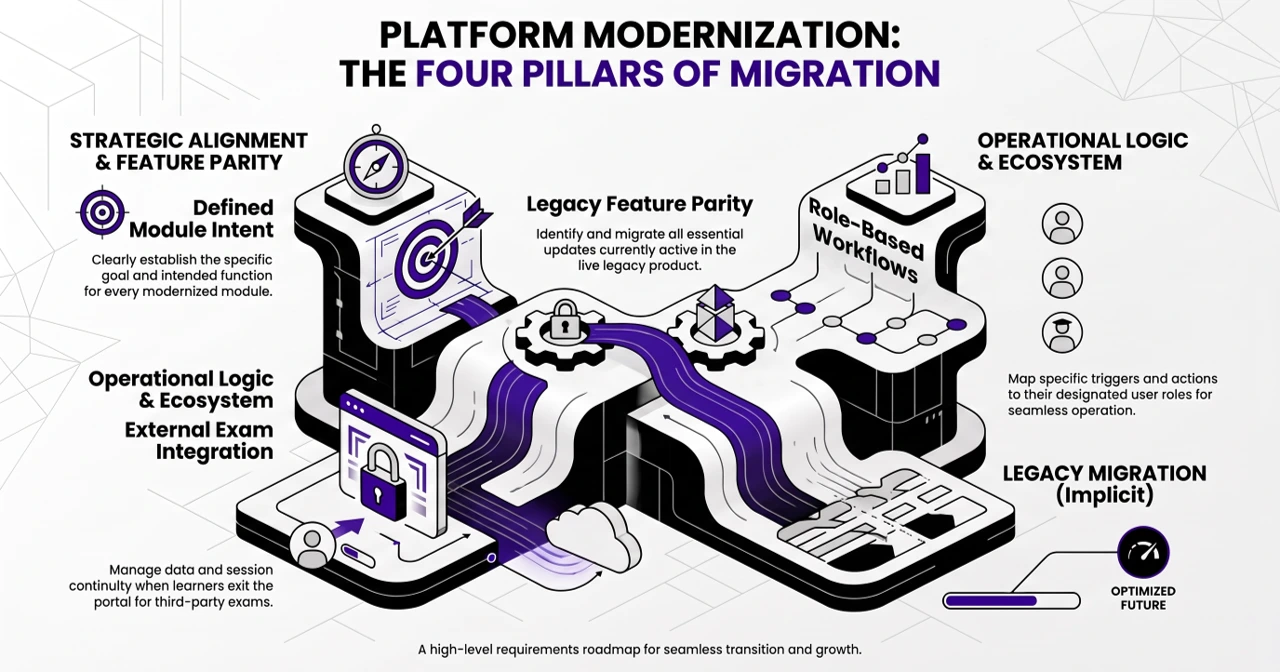
The problem was whether that technical understanding represented the product the business and its customers depended on. What was each module intended to do? Which user roles triggered which workflows? What happened when a learner left the portal to complete an exam in another application? Which changes made to the live legacy product still needed to be carried into the modernized platform?
In this blog, I will demonstrate why a functional and technical understanding of a product is critical to AI-native product modernization, and how a gap there can produce the wrong product.
System Understanding: Bottlenecks in AI-Native EdTech Product Modernization
A working education product contains far more than code.
It includes:
- Business rules accumulated over years
- Permissions and behavior across different user roles
- Database relationships and expected outputs
- Connections to other applications
- Customer and product-specific configurations
- Operational processes surrounding the application
- Knowledge held by AI-native engineers, product owners, business analysts, and support teams
An AI agent can identify a dependency. It traces where a method is called, explains what a module appears to do, and generates documentation around that interpretation.
But the project team still needs to establish whether that interpretation matches the product’s intended behavior.
This is very difficult to do when the application was acquired. We’ve seen edtech products acquired; the original engineering team is no longer involved, and the current organization doesn’t work in the technology stack the product was built on.
Finding the code is easy in these cases, but what is that code supposed to preserve?
Access and environment approvals still matter. In our own engagement, working within the customer’s network and obtaining approval for AI tools took time. But those were delivery conditions. The deeper product risk was that the customer owned a working application without possessing a complete, usable understanding of how it worked.
A Magic EdTech AI Modernization Case Study
In a recent engagement, our team modernized a certification portal that the customer had acquired from another organization.
The application had been built using Python and PostgreSQL. The customer’s broader technology ecosystem ran on .NET Core, Angular, and PostgreSQL. They didn’t have an internal team trained to maintain the Python application, and lacked a sufficiently detailed knowledge base explaining its features, modules, and behavior.
The application was also more than a basic learner portal.
It supported several user personas, including administrators, faculty members, instructors, and students. Faculty could create courses and schedule examinations. Students could apply for an exam and then move into a separate application to complete it. The examination result would return to the certification portal, where the final credential could be issued.
That intricate journey had to survive the modernization.
Before the engagement began, the customer shared the legacy codebase with us. Using our AI-enabled workflow, we analyzed the application and identified:
- Its modules
- Its dependencies
- Its approximate size and code volume
- The structure of the application
- The areas that would need to be transformed
The resulting inventory closely matched the document created by the customer’s existing application vendor.
That gave the customer confidence that AI could help a new engineering team understand an unfamiliar application quickly. But it did not remove the need for validation.
As the application was rewritten, a technology specialist reviewed the AI-generated code. Business analysts checked whether the functionality worked correctly. The customer’s product owners validated the business logic, user roles, and end-to-end workflows.
We also generated documentation for every module being modernized, covering what it did, why it existed, and what outcome it was expected to produce.
That documentation was one of the main outcomes the customer needed from the modernization.
What Causes AI Modernization to Get Stuck at the Understanding Stage?
Two problems tend to appear at once. Either one can create rework even after the agents have successfully analyzed the repository.
Problem 1: The Code Shows Behavior, but Rarely Explains Intent
AI agents can do a great deal during modernization. They can:
- Inspect an entire repository
- Identify modules and application boundaries
- Map dependencies across the codebase
- Trace existing business logic
- Generate or modify code
- Produce initial technical documentation
- Run tests and support validation
That creates a strong technical model of the application.
What it does not automatically establish is whether every discovered behavior is still intentional.
A condition in the code may be an important business rule. It may also be an old workaround that nobody needs anymore. A user-role exception may support a real product requirement, or it may have survived simply because nobody understood it well enough to remove it.
This is why documentation needs to explain more than classes, functions, and endpoints. For every significant module, the modernization team needs to understand:
- What does this module do?
- What is its business purpose?
- Which user roles rely on it?
- What outcome does it produce?
- What other modules or systems depend on it?
- Which parts of its behavior must remain unchanged?
In our certification-platform engagement, preserving the same interface was only one part of the job. The harder work was validating the business logic and workflows behind that interface across different user personas.
A screen can look identical while the product behaves differently underneath it.
Problem 2: Important Product Behavior Lives Between Systems
Incomplete documentation makes connected applications especially dangerous.
The learning portal did not complete the entire learner journey by itself. Students moved from the portal into another application to take an examination. The result then returned to the original portal and contributed to the certification outcome.
The connection was part of the product, even though part of the experience took place outside the application being rewritten.
This is why a dependency list can be insufficient. It tells the team that two systems connect, but fails to explain:
- Why the connection exists
- Which workflow activates it
- Which user role initiates it
- What information must move between the systems
- What the receiving application is expected to do
- What outcome confirms that the full journey worked
The same problem appears across edtech and publishing platforms wherever products connect with assessment engines, identity services, LMS platforms, SIS platforms, content systems, payment providers, reporting tools, or customer-specific applications.
An agent can often find the technical connection quickly. AI-native engineers, business analysts, and product owners still need to validate the behavioral contract around that connection.
Otherwise, the modernization team may produce a cleaner application while damaging the workflow the application exists to support.

How Does Incomplete System Knowledge Cost an EdTech or Publishing Business?
Once system understanding starts expanding during delivery, the cost appears in two places at once: the business and timeline, and the product and user experience.
The Business and Timeline Impact
Incomplete documentation makes modernization estimates less dependable.
A codebase can be measured by its language, framework, repositories, modules, and lines of code. The time required to reconstruct product intent is harder to calculate. It depends on how many rules remain unexplained, how many connected systems are involved, and how many people need to validate what the code appears to be doing.
That can create an awkward situation for the customer. The organization may have brought in a modernization partner because its internal team lacked the capacity or skills to maintain the legacy application. Yet those same internal teams need to have an SME to answer product questions, validate workflows, and explain how the application fits into the wider ecosystem.
The legacy application also has to remain in service while that work continues.
In our engagement, the customer’s team kept fixing bugs and making necessary enhancements to the live application while modernization was underway. Our team then had to take the latest version of the legacy code and carry those changes into the replacement.
That creates more than additional coding work. Every change can affect:
- Previously analyzed business logic
- Generated module documentation
- Existing tests
- Dependencies already mapped
- Modernized components that were considered complete
The longer the two versions develop in parallel, the more carefully that change needs to be controlled.
The Product, Team, and User Impact
Users may not see any immediate disruption because the legacy application remains live. That can make the project look safer than it is.
The real risk appears when the replacement is tested as a complete product.
A modernized application may compile successfully and still contain problems such as:
- A role receiving the wrong permissions
- A workflow ending in the wrong state
- A result failing to return from a connected application
- A business rule producing a different outcome
- A recent legacy enhancement missing from the replacement
These are not cosmetic differences. In a certification application, they can affect whether a learner can apply for an examination, complete it, receive the correct result, and obtain a credential.
This is why our validation approach involved more than technical code review. Business analysts verified functionality, and customer product owners reviewed workflows and business logic.
The project also planned to operate the legacy and modernized applications in parallel before the complete cutover. Where formal documentation is incomplete, the running legacy system becomes an important reference for expected behavior.
That comparison takes time. Compressing it at the end of the project simply moves the uncertainty closer to launch, which is the least useful place to discover that the new application and the old one disagree.
How Do You Sequence AI-Native Modernization the Right Way?
Solving this does not require documenting every line of the legacy product before modernization begins. That could turn discovery into a project with no natural end.
It requires two practical structures: an early system-comprehension phase and a documentation process that continues alongside delivery.
1. Run a System-Comprehension Preflight Before Full Delivery
Before deploying several engineering squads, use AI-assisted analysis to create an initial model of the application.
The preflight should establish:
- The major modules
- Direct dependencies across the codebase
- The main user roles
- Critical business workflows
- Connected applications and systems
- Areas where business intent is unclear
- The current and target technology stacks
- The legacy changes that will continue during modernization
Then take one representative workflow through the complete modernization and validation process.
The chosen workflow should not be the easiest isolated module. It should test the types of risk that will matter later.
For a certification platform, that might include:
1. A learner entering the portal
2. The correct role and permissions being applied
3. The learner applying for an examination
4. The handoff to the examination application
5. The result returning to the portal
6. The certification outcome being produced
That proves more than whether the agent can convert code. It shows whether the team can reconstruct and preserve a connected product journey.
In our engagement, the initial AI-generated module and dependency inventory closely matched the incumbent vendor’s analysis. That gave the customer an evidence-based reason to trust the workflow before the full modernization had been completed.
2. Document the Product, Not Just the New Code
Documentation should be generated as part of modernization, then validated by the people responsible for the product.
For each module, the documentation should capture:
- Its purpose
- Its functional intent
- The outcome it produces
- The user roles involved
- The modules and systems it depends on
- The workflows in which it participates
- The tests used to validate it
- Any assumptions that still require confirmation
AI agents can produce the first version quickly. That output should then move through the same validation model as the application:
- Technology specialists validate the technical interpretation and generated code.
- Business analysts validate the functional behavior.
- Product owners confirm that the workflow reflects the intended product.
- Engineering teams update the documentation when the live legacy application changes.
Documentation generated at the beginning of the project will become stale if the legacy product continues receiving fixes and enhancements.
The documentation has to be treated as part of the working modernization system, not as a report produced once and filed away.
Why This AI-Modernization Sequencing Pays Off
This process uses AI where it creates the most value and adds human judgment where technical inference is not enough.
AI can dramatically reduce the time required to enter an unfamiliar codebase. It can identify modules, dependencies, and business logic that would otherwise take engineers weeks to trace manually. It can also create documentation while those modules are being transformed.
This will change your modernization equation.
The customer does not have to arrive with perfect knowledge. The modernization process can help reconstruct one.
The customer also gains more than an application on a newer stack. It gains:
- Documentation future developers can use
- A clearer understanding of module intent
- Better visibility into application dependencies
- A product aligned with the organization’s standard technology ecosystem
- A stronger foundation for future fixes, enhancements, and integrations
- Less dependence on a small group of people who understand the legacy platform
The delivery team gains a more reliable basis for estimating, testing, and accepting the work. Technical teams, business analysts, and product owners are validating the same system model rather than discovering different interpretations near launch.
So, What Is the Lesson?
To me, it is clear:
“AI can reconstruct an unfamiliar codebase quickly. Modernization succeeds when the team also proves that the reconstructed system reflects the product people depend on.”
That is how we structure AI-native modernization at Magic EdTech. Our AI-enabled technology development approach combines agent-led analysis and transformation with technical review, functional validation, and documentation that becomes part of the finished product.
Moving an application to a newer stack solves the technology problem. Moving it without preserving what the organization knows about the product simply rebuilds the same maintenance problem in newer code.
Get in touch to discuss how your legacy platform can be modernized without losing the business logic and connected workflows that keep it working.
FAQs
Ask for a module-and-dependency inventory, a list of unresolved business questions, and one representative workflow taken through modernization and validation. Choose a journey with role permissions and a cross-system handoff, not an isolated module. Use the remaining uncertainties to decide whether the team is ready to expand delivery, not how much code it generates.
Treat code-derived behavior as a working interpretation, then compare it with the running application and the outcomes product owners expect. For each important rule, record its purpose, affected roles, expected result, and dependencies. Leave unresolved assumptions visible instead of letting an AI-generated explanation become an unexamined requirement.
Do not use successful compilation or a matching interface as the release criterion. Compare role permissions, business-rule outcomes, cross-system results, and recent legacy changes with the agreed product expectations. Resolve discrepancies with product owners, and use parallel comparison to validate complete journeys rather than treating one successful workflow as proof that the whole product is ready.
The modification of a live system means revalidation of the replacement, documentation, and tests, not just modification of the source code. Assess whether it affects the previous business rules, dependencies, or expectations, and update them if needed. A module should not be called "complete" at the delivery-plan stage if the behavior has changed.
Separate technical execution from decisions about product intent. In the engagement described here, Magic EdTech combined AI-assisted analysis and transformation with technical review, functional validation, and module documentation, while customer product owners confirmed workflows and business logic. Plan for that internal review time even when a partner handles the implementation.

Get In Touch
Reach out to our team with your question and our representatives will get back to you within 24 working hours.